

The Later Series
This is the final of three major categories for late sixties Les Pauls. As we progress through these three sections, the construction of the guitars will get further and further away from the 1950's style (and will decrease in value). It is important to remember to make up ones own mind about the merits or pitfalls of these changes. A guitar from any one of these sections could easily be perfect for you. Also, unofficial production numbers from this era indicate that production increases as we progress. This implies that each succeeding era becomes more common.
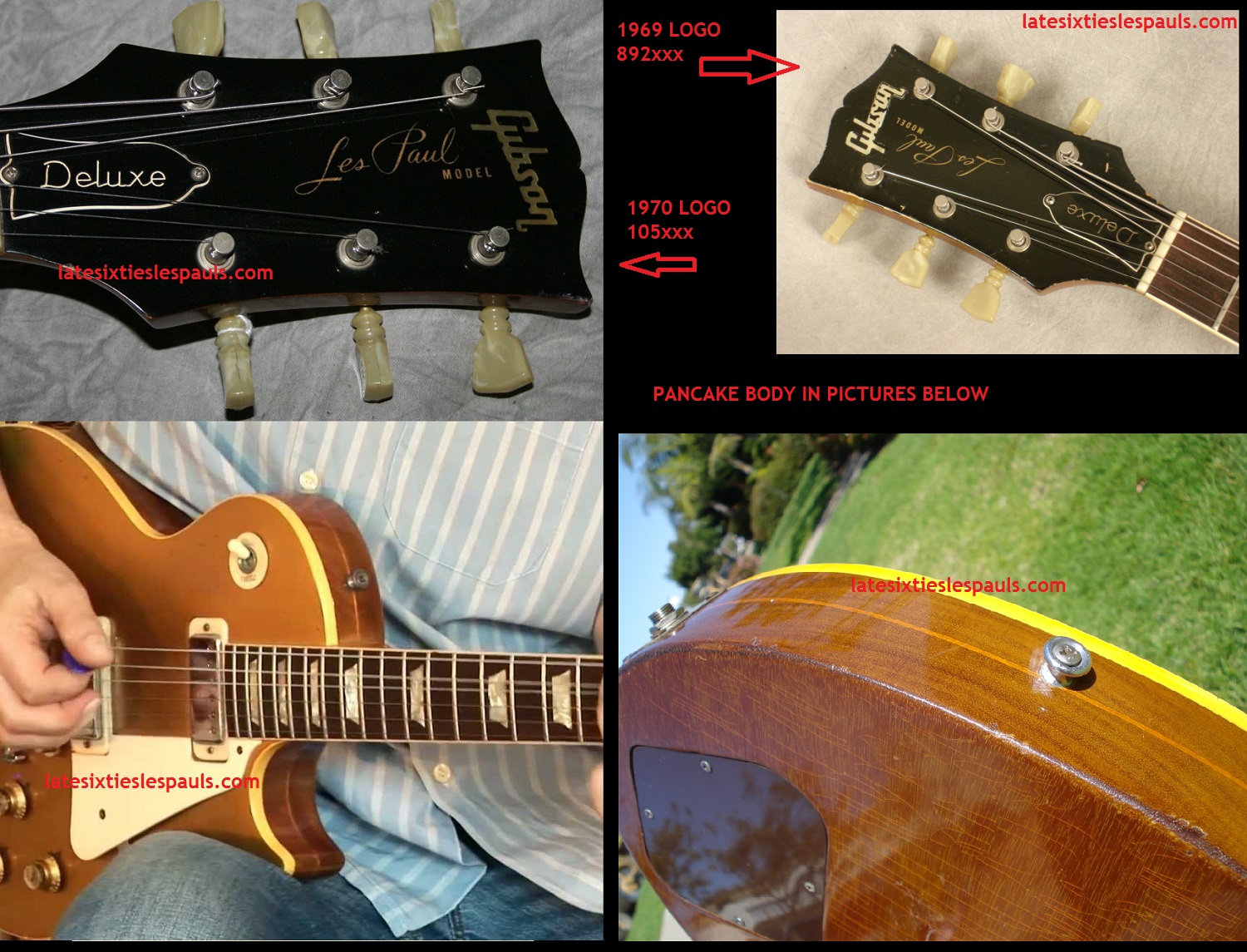
The Later Series are great guitars. Although they exhibit nearly completely un-50's design, they are increasing collectable and have produced many famous recordings in the 1970's. Most of the "Later Series" design features continue with few changes until nearly 1975. Their bodies are exclusively the 3-pc, sandwich design. (Also known as "pancake"). The necks are 3-pc construction throughout. The headstocks gain a little bump on the back known as a "volute" around serial 887xxx or more likely around 892xxx. NOTE: It is NOT the finalized voltue common to all 1970's instruments. Instead, it is a soft rounded hint of a bump. Easy to miss in fact.
Features:
BASIC CONSTRUCTION:
Honduran Mahogany as stated in the flyer released in 1968. Maple top. Three-piece mahogany neck (with two little seperate wings to form the holly shaped headstock) throughout this category. Multi-pieced, non-center seamed maple tops. Let it be noted that many, if not nearly all 50's Goldtops had non-center seamed tops. Genuine, sandwich (pancake) body appears. Pure transitional tenon route that barely extend into the pickup cavity. (AKA, not under the pickup's center like a LT.) This shorter route probably comes into the neck cavity by about a quarter inch whereas the long tenon route was about 3/4 of an inch. The pancake body consists of a piece of what appears to be maple (not sure) sandwiched between two approximately 3/4" thick mahogany slabs. Only the mahogany layer on the back of the guitar is one piece. The internal layer can be several. Basically, these two slabs of mahogany and the "maple" add up to the same dimension that previous eras used only a single piece of mahogany for. This feature continues into the mid 1970s.
HEADSTOCK:
Volute added to the back of headstock behind the nut. The 1970's Gibson volute began as a barely distinguishable bump in 1969. It later became a sharply carved ridge. (Search Ebay for any 1970's Les Paul to see a picture of one. Ill have images here asap.) Precise serial number range for addition of volute is unclear with existing data.
New Les Paul Guitars, Bass, & Amps:
Developed in 1969 --- Shipped in 1970
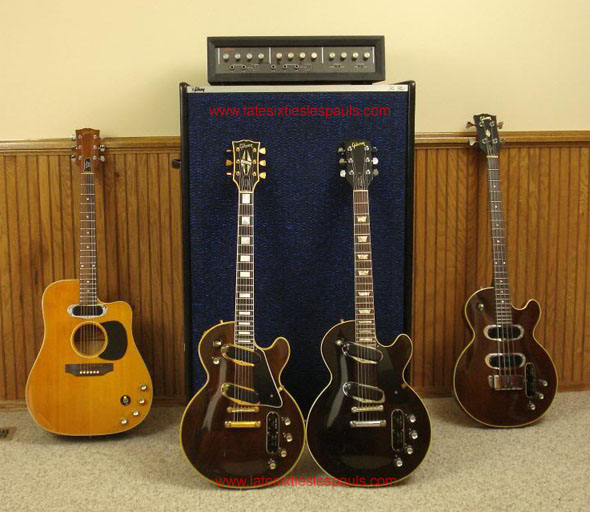
Courtesy of George (Grog @ LPF)
As part of the renewed partnership between Les Paul and Gibson, they co-developed several new models of string instruments and amps. The new stringed instruments included: the "Les Paul Professional", the "Les Paul Personal", the "Les Paul Jumbo" and even a "Les Paul Bass model". The bass model is very similar in looks and function as these Personal & Professional model guitars. The "Les Paul Jumbo" was an acoustic/electric model and is extremely rare these days. All of these new 1969/1970 models feature low-impedence pickups which can require a special adapter (pictured in the LP Personal section) to be used on a conventional amp. Also, the LP-1 solid state amplifier was introduced.
Want to learn more? Click on the image below to visit the "Featured Article" about this era of New Les Paul designs.
CLICK THIS IMAGE TO LEARN MORE