

Common Features:
The following is a description of features common to the entire era of LSLPs. I also intend to eventually add a comprehensive "case candy" section to exhibit the documentation common to all instruments of this era. It will be in the "Period Literature" section. All case variants are common to all models (Standard, Deluxe, Custom). Information on cases is contained in the "Case Guide".
A great Joe Ganzler quote from the LPF, 1-15-2004: "I will still also concede that some of THE best Les Pauls I've ever heard and played were '68's that have been routed for 'buckers!" ---- EDIT (from the author of this site): Although please people, don't start routing your guitars! :) :) :)
NECK SHAPE:
Can be very 50's-ish. They are pretty inconsistent, but generally could be considered larger-than-typical, 60's Gibson necks. Some 68 owners have reported that their necks are nearly identical to mid-50's Customs that they own. I have also encountered direct comparisons to the mid-sized 1959 neck shape. From a very good source, my early 69 has a "56/57 neck shape". The heal shape is not quite the same as it is more of a D shape than a 50's C. Believe it or not, there are some baseball bat huge necks that left the plant in this era, but they are the exception and not the norm. Necks taper in thickness from the heel towards the nut. They have a full nut-width, unlike most 60's Gibsons.
BASIC CONSTRUCTION:
Honduran Mahogany as stated in the flyer released in 1968. The good stuff. Also, a Maple top.
HEADSTOCK:
Wood veneer. Not sure what kind, but I'm certain its wood and not plastic. Headstock pitch is a shallower 14 degrees instead of the 50's 17 degrees. This is what is commonly seen as one of the primary differences between a 50's Les Paul and a 1968 Les Paul. The truss rod cover is closer to the nut on late 60's Pauls vs. 50's.
BASIC ELECTRONICS:
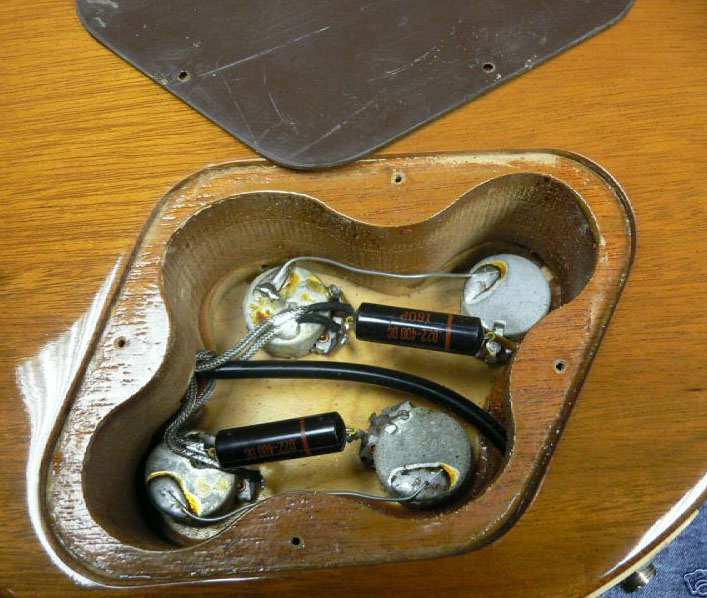
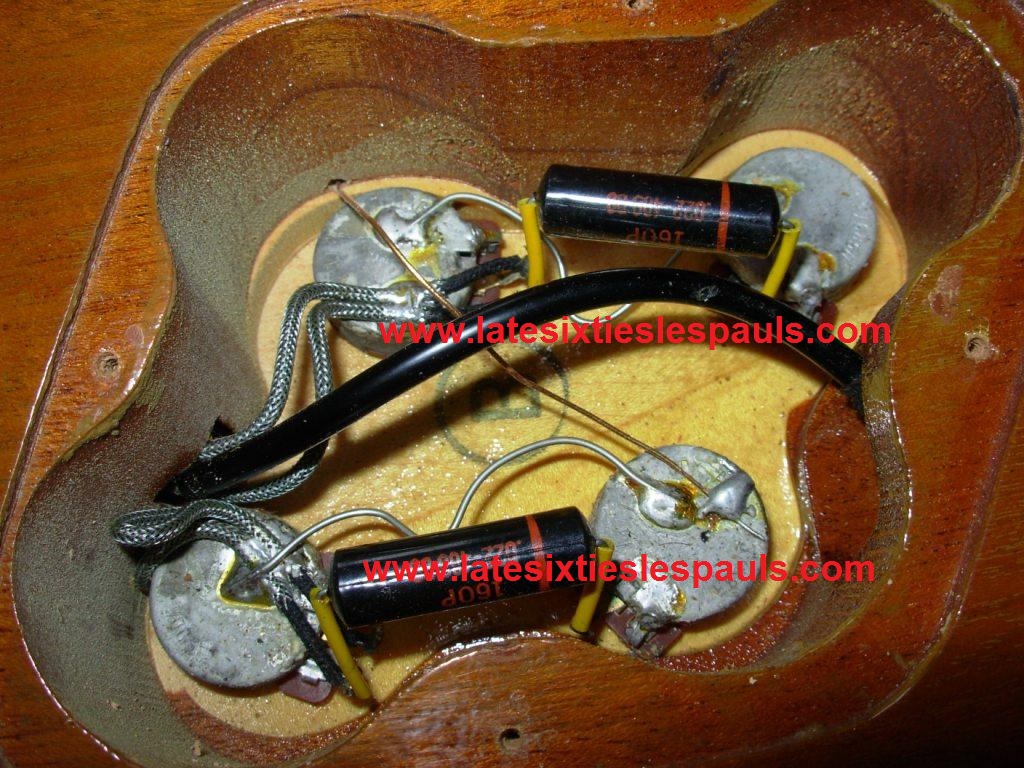
"Black Beauty" Spragues. These have been x-rayed and confirmed to be IDENTICAL to 50's bumble bee caps in every way. In essence, they ARE bumble bees. The outer color scheme is simply different. I'm not sure what brand the pots in 68LP's are. I will also eventually have wiring diagrams available. I need to do some leg work to confirm what an unmolested scheme should be. 68's are early 69's use 50's wiring, with the caps moving to a different lug on the tone pots thereafter. I am not sure of when the change occurred. "Switchcraft" brand pickup selector switch.
GIBSON HEADSTOCK LOGO:
Earlier guitars in the run will have a dot over the "i" in Gibson, whereas later guitars will NOT have a dot. The dot disappears in very early 1969. An open 'b' and 'o'. Certainly not the smooth, all closed lettered 70's logo until potentially in the later reissue stage (which probably overlaps into early 1970 a little bit).
HARDWARE:
Wired ABR's with no anchors in the wood. LIGHTWEIGHT tailpiece. Strap buttons are the classic Gibson style. Bridges have nylon saddles. Some 68's and early 69's I've seen have a regular screw holding the pickguard to its bracket, not a Phillips. Customs are gold plated of course. 68 Brochure states that Standards have nickel hardware, but I believe them to have a mixture of nickel tuners and accessories (likes screws) while having a chrome ABR and Stop Tail. Write me if I have this wrong, it's something really obvious that I somehow have glossed over. :) The ABR's will have a patent number on their bottoms. (Pat. No. 2,740,313)
NECK ANGLE:
They vary as they did in the 50's, but generally they have an angle that lends itself to an ideal, low-mounted ABR. Cool stuff.
BODY SHAPE:
The carves have MUCH more detail to them than the generally maligned (for cosmetic reasons only of course) Norlin "dome" carve of the 1970s. They have a flat deck where the pickups are mounted just like a 50's guitar. I would say they are generally very similar to a 50's carve except that a DEEP dish carve is much less common, with a slightly less deep edge the norm.
WIRING:
50's wiring through early 1969, precise date / serial relationship not studied in detail yet.
NECK JOINT:
Non-rocker joint. AKA, a flat bottomed mortise and tenon joint. Les Paul's made after the mid 70's have a rounded bottom on their tenons to facilitate a wider acceptable tolerance in construction. The late 60's and early 70's joints are more commonly considered the superior technique. Early “long tenoned” examples bring the most money and are accurate to 1950 specs. (Although, 1950's guitars have a rounded tenon end vs. the 1960's examples having a beveled edge).
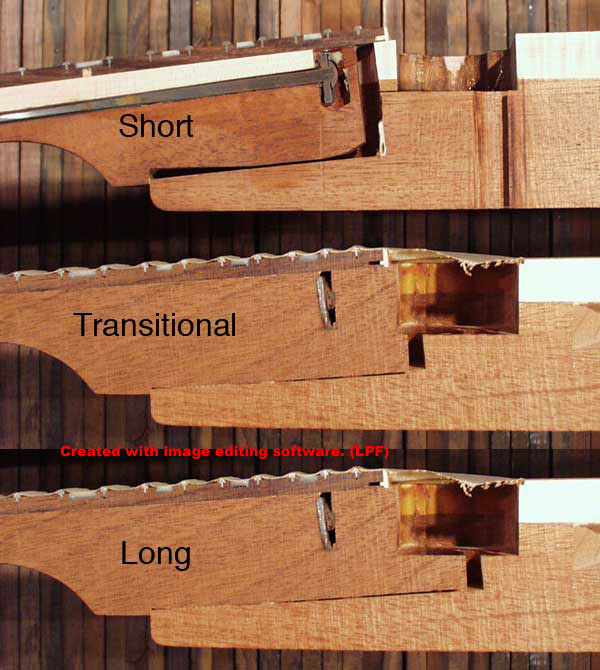
They were followed by what I refer to as a “transitional tenon”. A “transitional tenon” is identical to the “long tenon” other than the fact that it does not extend underneath the neck pickup.
The term “short tenon” is usually ascribed to the later rocker joints. Although, it is sometimes used in reference to the “transitional tenon”. I refer to this mid-1969 through mid/late 70s tenon as transitional because it comes after 11 years production of long tenons and before multiple decades of rocker joints in regular production models.
CAVITY ROUTING:
Guitars actually built earlier in the run (aka, shipped in 68) tend to exhibit routes with straight walls and a flat maple floor. Basically the earlier guitars had their cavities routed BEFORE the maple cap was applied. Later guitars were routed in the traditional 50's style AFTER the maple cap was applied. This leaves a little shelf at the bottom of the cavity and a slanted wall in some places.
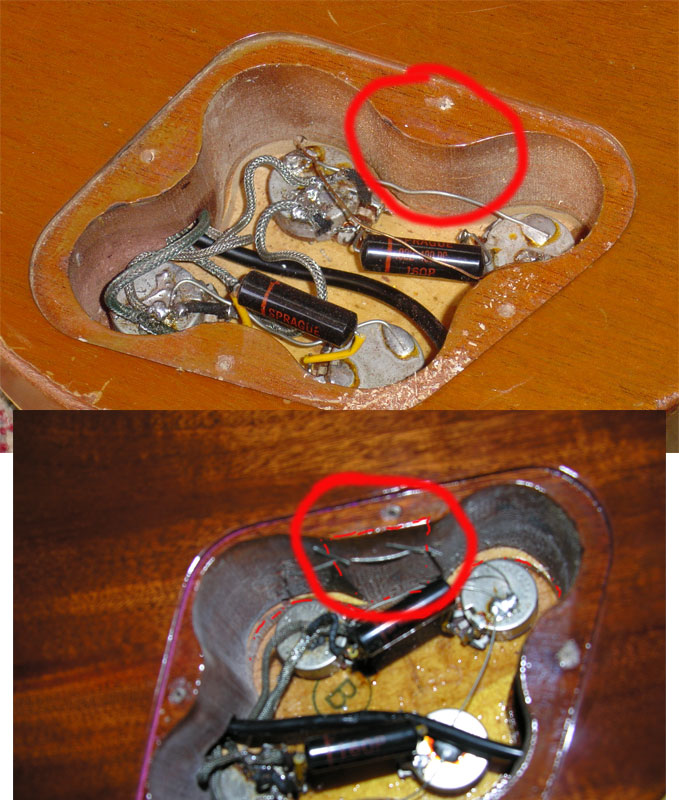
So, earlier guitars will have the inaccurate cavity route, whereas the later ones will be more accurate in this respect. The wiring channel from the pickups will be the small square route typical of 50's guitars. The square is about 3/4 of an inch on each side. It emerges in the cavity slightly further down from center between the pots than a 50's guitar will.
Les Paul Custom Specific Info:
1968 Retail price: $545.00 --> $3547.91 in 2012 dollars
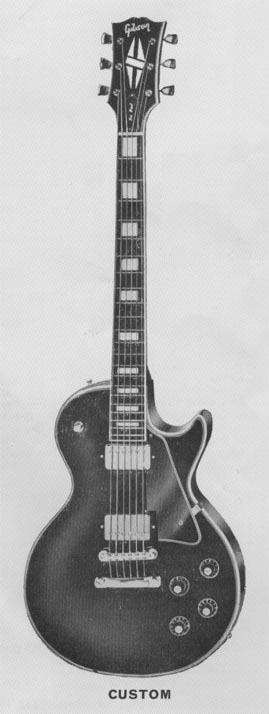
1968 Customs are different from their 50's counterparts in a number of ways. I've already discussed some of these differences above. The primary difference lies in the body construction. Simply, LSLP have maple tops, whereas 50's examples had solid mahogany bodies. In fact, a 68 Custom has more in common with a late 50's Les Paul Standard than most people think. It has the same basic construction: same woods, same neck joint, same pickup type, same pickup rings, same bridge, uniform binding, same capacitors, lightweight tailpiece, etc... In a simplified manner, one can imagine that a 68 Custom is a 50's standard with an Ebony board and a different ascetic scheme. Late 1960's Les Paul Customs were only available in Black. However, I have seen ONE, verified LP Custom in Gold. It can be viewed in the Oddities, Lefties, and Unconfirmed section.
FINGERBOARD:
Ebony
INLAYS:
Mother of Pearl, block inlays. There is a slight difference in design between 50's and LSLPC's that is often overlooked. The 17th,19th, & 21st fret's inlays are a uniform thickness relative to the nut and bridge on a 50's guitar. A late sixities LPC will have a thinner inlay on the 21st fret. I have confirmed that single cutaway, LP Customs in 1960 (and the few that trickled out in 1961) had the same thinner inlays as LSLPC's. They seem to have picked up where they left off.
HEADSTOCK:
Split-diamond inlay.
PICKUPS:
Early, T-Top, Patent Sticker humbuckers. The Pat. No. sticker on the bottom of the pickup reads "PATENT NO 2,737,842". BUT, there's a little room for debate on bobbin type. I have personal experience with an early 69 (shipped April 3rd 1969) Custom that has two original, NON T-Top, Patent Sticker humbuckers (Orange wire, white and black leads).. My guess is that a few non-t's filtered out as the change to T-tops was made. Typical output is around 7.5k. "Short" magnets, aka, not the longer ones used in the first PAF humbuckers through 1960, but the ones found in later PAF's and 60's pickups. (BTW, if anyone out there is asking themselves what the hell a "T-top" pickup is, Id be happy to explain. The plastic that one sees as the main component of a pickup is called a bobbin. Simply put, a "T-top" bobbin has a letter 'T' on it. Yup, that simple. The non-T's are using bobbins that are somewhat but not overly similar to the earlier, famous PAF's.)
PICKUP LOCATION:
Humbuckers on one early 69 example (559xxx) exhibit a 50's-esque, 2.25 inch space between them. This guitar also had the gap between the end of the fingerboard and the neck pickup with its tenon visible. This gap and the distance between the pickups is typical of 50's guitars as well.
PLASTIC:
Engraved truss rod cover. The words "Les Paul Custom" are engraved about a sixteenth of an inch or so deep. The brochure introducing the 1968 series Les Pauls show a Custom with just the words "Les Paul" on the truss rod cover. Genuine M-69 pickup rings at least until early 1969, possibly further. (Black) Tall, 3/4 inch bridge ring. These are 50's style rings. (CONJECTURE: They are most likely leftovers from the 50s or early 60s as many SG's used M-69 series rings.) "Witchhat" knobs with gold colored inserts. The inserts will say ' VOL' or 'TONE' accordingly. The switch backplate on 50's guitars is 2ml (about 1/8th of an inch) larger in diameter than LSLP according to one source.
BINDING:
Uniform depth binding. Unlike the 68 Goldtop, the Custom has the accurate 50's binding which is the same height around the top of the guitar, even in the cutaway. A custom will have binding on both the front and back of the body. The neck will be bound, and the headstock will have ornate binding just as the body does. The binding can turn yellow or orange with age.
TUNERS:
Waffle back tuners with gold buttons. Les Paul Customs from 1954 through around 1959 will have identical tuners but with plastic tipped buttons (ala Les Paul Standard). These tuners will NOT have Patent Numbers on their back as 50's examples would.
Les Paul Standard / Deluxe Specific Info:
1968 Retail price: $395.00 --> $2571.42 in 2012 dollars
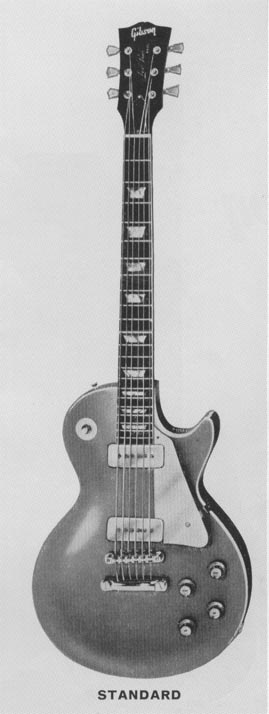
1968 Goldtops are incredible and yet puzzling guitars. If one follows the development of Gibson's Les Paul Standard model and then tried to guess what a 68 Standard would look like, you'd most likely assume it would be a humbuckered sunburst with uniform binding. Somehow, Gibson decided to rewind the clock to the Standard of late 1955 - early 1957 by going back to a Goldtop finish with P-90 pickups. They also used thick binding in the cutaway instead of uniform binding. Regardless of how weird Gibson's decision was, the resurgence of the P-90 in recent years has cancelled out any stupidity of Gibson at the time. With such neglidgable differences between this instrument and a 50's Goldtop, a 1968 model is a very enticing option for those budget minded Goldtop hunters. (50's examples with an ABR wont sell for less than $30,000 in any reasonable condition, whereas as a clean-ish 68 can be found for a "mere" $8,000-$12,000. As of January 06.) Late 1960's Les Paul Standards were only available in Gold. Around the middle of May in 1969, these guitars were fitted with Gibson's "Mini-Humbuckers" with Patent Stickers on their base, a transitional tenon, and a 3pc neck. From then on, they are known as a "Deluxe" model (as written on their truss rod covers.) This change occurred around the 564xxx-565xxx serial range, and truly began with the birth of the 8xx,xxx serial range.
FINGERBOARD:
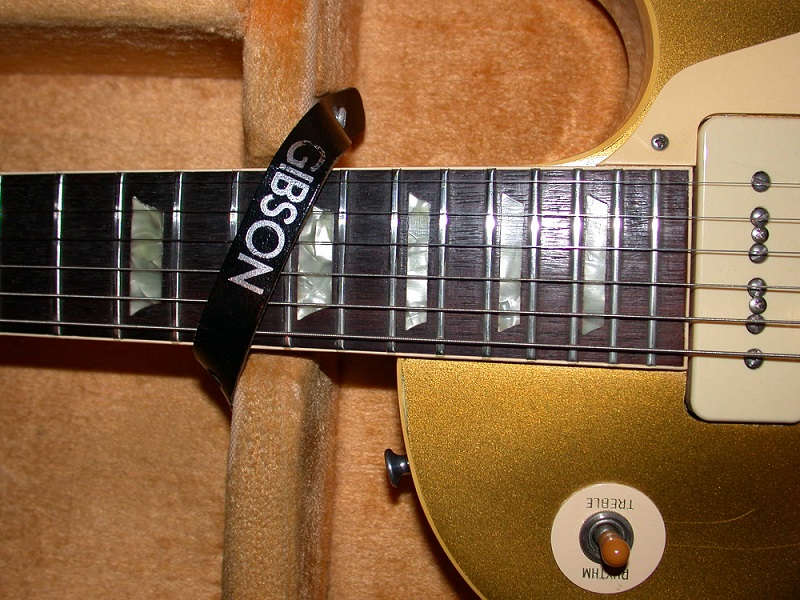
Indian Rosewood. Yep, not Brazilian Rosewood which Gibson phased out the previous few years.
INLAYS:
They have more rounded corners than 50's examples. I have seen one "First Reissue", a VERY early example with an 89xxxx serial, which has the sharp corner, 50's shaped inlays. Gibson kept using the round edged inlays until 2003 when they sharpened them up on the current Historic line. The material itself is different than the 50's inlays.
HEADSTOCK:
"Les Paul Model" silk screen OVER the finish. The earliest examples of Goldtops had a mother of pearl inlay in the shape of a crown where the "Les Paul Model" silk screen should be. Standard 50's headstock shape and tuner placement until early in 1969. In order to save money by only having to cut one headstock size for both the Standard and Custom series (an educated guess, not fact), Gibson increased the size of the Goldtop's headstock.
PICKUPS:
Standard 60's, P-90s. They even had the cool, proper white plastic covers unlike Gibson's current line of reissues. [EDIT: This was corrected in 2009; they are correct now.] I'll have more information on bobbin color, etc as time goes on. From what I understand, the output of the pickups conforms to the standard of the time. Nothing special one way or another. I have seen examples with both clear and black bobbins. I'll add more to this when I can.
PLASTIC:
Whiter plastic guard and pickups than modern Gibsons which typically use a dark cream colored plastic. Beginning in 2009, the Historic series finally has the correct white plastic color on the pickup covers and pickguard. The truss rod covers vary for GTs. Some are blank, some say 'Les Paul', 'Deluxe', 'Les Paul Deluxe'. Gold knobs with chrome inserts on the top, also known as "reflectors". The inserts will say ' volume' or 'tone' accordingly.
BINDING:
With the introduction of the 1968 Les Paul Goldtop, Gibson changed the body binding to cover the maple that would peek out in the cutaway of a natural back finished GT. Therefore, the binding is NOT uniform in its thickness like a Custom or a 50's GT. It is THICKER only in the cutaway. This is the standard binding setup by which ALL Les Pauls would use until the Historic line was introduced. (With a few exceptions of course, but that is a matter for some other website.)
TUNERS:
NICKEL PLATED. Standard double line tuners, with double ring tuning buttons. Just take a look at some GT's tuners, you'll immediately know what I mean by double ring. The tuners are standard mid-late 60s "Kluson Deluxe" models. (They say "Kluson Deluxe" in two lines.) They are commonly called "double ring, double line" tuners. They do not have any patent numbers on their underside like early 60's double ring tuners. The 68 brochure clearly states "Nickel-plated metal parts with individual machine heads." . Here is an image of 68, nickel tuners: