

The Early Series
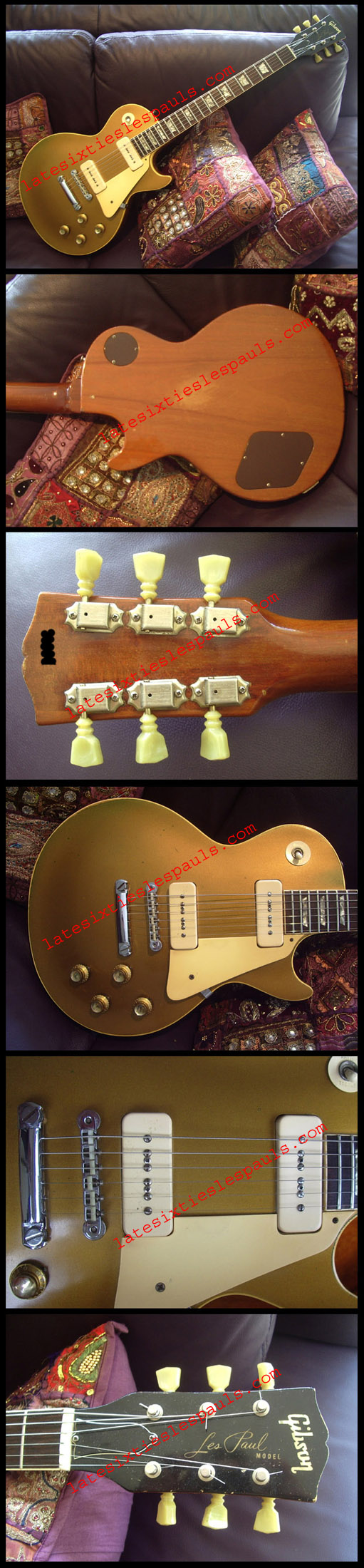
This is the first of three major categories for late sixties Les Pauls. As we progress through these three sections, the construction of the guitars will get further and further away from the 1950's style (and will decrease in value). It is important to remember to make up ones own mind about the merits or pitfalls of these changes. A guitar from any one of these sections could easily be perfect for you. Also, unofficial production numbers from this era indicate that production increases as we progress. This implies that each succeeding era becomes more common.
The Early Series are fantastic instruments with thoroughbred heritage to boot. They are the most sought after of LSLPs by far. They display decidedly 50's construction throughout and offer a great alternative to an older example. When you hear the blanket term "1968 Les Paul" in guitar nerd conversation, it generally refers to this era even though a good bit of these guitars were made in 1969. This is the era that Gibson chose to base their "1968 Les Paul Custom Reissues" on. They are covered in the "Current Reissues" section.
Features:
PICKUPS:
Concerning Standard models only, P-90 pickups exclusively.
BASIC CONSTRUCTION:
Honduran Mahogany as stated in the flyer released in 1968. Maple top. One-piece mahogany neck (with two little separate wings to form the holly shaped headstock) throughout this category. Center seamed maple top throughout. One-piece mahogany back throughout.
NOTE: Approximately around serial number 535-537xxx in early 1969, a sixteenth of an inch laminate of maple appears ABOVE the standard depth 1pc mahogany back. It is very difficult to see, but can be observed in the neck pickup cavities of Customs and Standards alike. This is the mysterious "cross-banded layer". No one has a good explanation for it as it would add time, labor, and $$$ to assembling an instrument. One of the first to have it, here is an image of a 537xxx guitar with a small headstock, dotted "i", and a 69-style cavity: IMAGE OF LAYER
NECK JOINT:
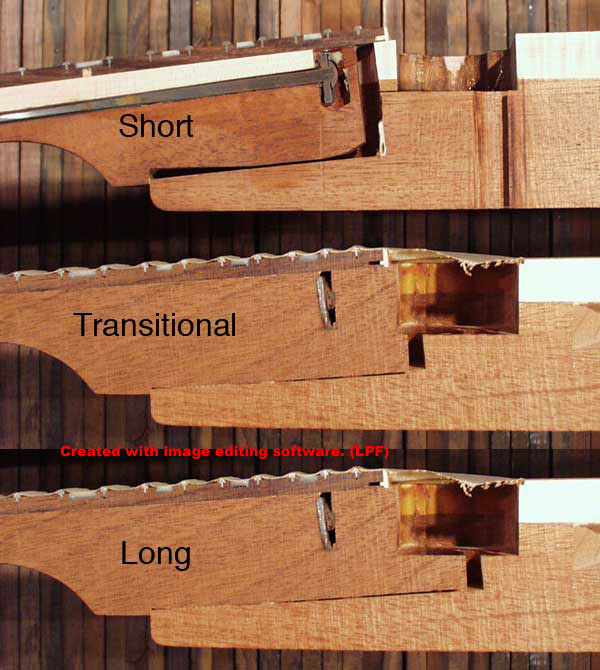
These guitars exclusively have a long tenon neck joint. The long tenon is commonly considered the superior technique for attaching a neck. These examples bring the most money and are accurate to 1950 specs. (Although, 1950's guitars have a rounded tenon end vs. the 1960's examples having a beveled edge). A long neck tenon will extend most of the way underneath the neck pickup. The neck pickup of a early reissue GT will be directly connected to the neck tenon. NOTE: A very small number of Middle Series guitars shipped with a long tenon body and a transitional tenon neck. This occurred ONLY in the 565xxx and the rare 600xxx serial range. Although absent on LP Customs (for obvious reasons), LP Deluxes have a block of wood crudely glued in to fill this gap. The block allows the mounting bar for the mini-humbuckers to be installed. Be careful to make sure what you are buying. This block is occasionally glued in with care and can appear to be a long tenon.
Note about this image: This is a photoshop hack job of an Historic Series Gibson that was cut in half. It is just for educational purposes and not precisely similar to the actual neck joints. Thanks.
HEADSTOCK:
The most sought after Goldtops of this era will have a 50's headstock design. Around serial number 53920x-53924x, Goldtops jumped to a larger sized variant. Remember, this ONLY affects GT's. Customs have had the larger headstock since the 50's to accommodate the multi-ply binding they exhibit. NOTE: GT's will now have the traditional 'Les Paul Model' silkscreen over the finish on the headstock. Wood veneer. Not sure what kind, but I'm certain its wood and not plastic. No 8xxxxx series guitars will have a small headstock. (EXCEPT, possibly the extremely rare "First Reissue" guitars. They may have serials in the high 899xxx range. SO RARE as to be statistically insignificant.)
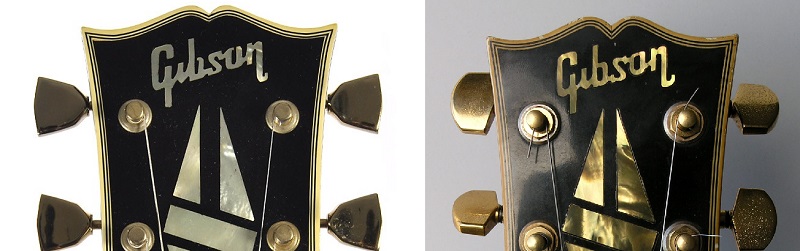
GIBSON HEADSTOCK LOGO:
Earlier guitars in the run will have a dot over the "i" in Gibson, whereas later guitars will NOT have a dot. An open 'b' and 'o'. Certainly not the smooth, all closed lettered 70's logo. The dot seems to disappear around serial 539,xxx in GT's. For Customs, the cutoff is less clear. I would guess it to be around 539,xxx, but I have heard of a 558,xxx Custom with one. Ill clarify Customs at a later date.
CAVITY ROUTING:
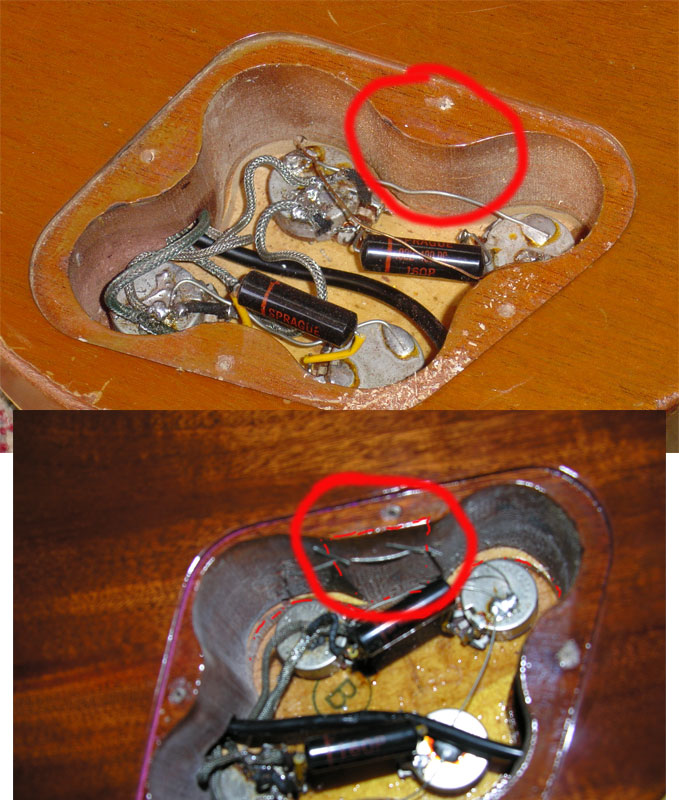
Guitars actually built earlier in the run (aka, shipped in 68) tend to exhibit routes with straight walls and a flat maple floor. (EDUCATED GUESS FOLLOWS: Basically the earlier guitars had their cavities routed BEFORE the maple cap was applied. Later guitars were routed in the traditional 50's style AFTER the maple cap was applied. This leaves a little shelf at the bottom of the cavity.) IN SUMMARY, earlier guitars (1968) will have the inaccurate cavity route, whereas the later ones (early 1969 and on) will be more accurate in this respect. This change occurs in early 1969 and remains in place for the remainder of LSLPs. The wiring channel from the pickups will be the small square route typical of 50's guitars. The square is about 3/4 of an inch on each side. It emerges in the cavity slightly further down from center between the pots than a 50's guitar will. (As observed on a early 69 example.)